Environment
We take responsibility for the climate and resources – with clear goals, measurable progress, and transparent methods. On this page, we show how we reduce greenhouse gas emissions along the value chain, make the product carbon footprint of our products traceable, and keep materials efficiently in circulation. To this end, we address key issues such as the circular economy and waste – and highlight the levers we use, the opportunities and risks that exist, and how we are improving our environmental performance step by step.
Key Facts:
- Our greenhouse gas target (Scope 1-3) has been officially validated by SBTi
- Our systematic approach to calculating the product carbon footprint has been validated by TÜV
- In the 2025 reporting year, a total of 369 tons of waste was generated, 91% of which was at production sites; 85% of this waste was non-hazardous.
Climate change
Climate change is a global challenge – for our generation and for future generations. We remain committed to doing our part to help achieve the Paris Agreement’s goal of limiting global warming to 1.5°C. At the same time, scientifically sound projections show that the 1.5°C target cannot be met by 2030.
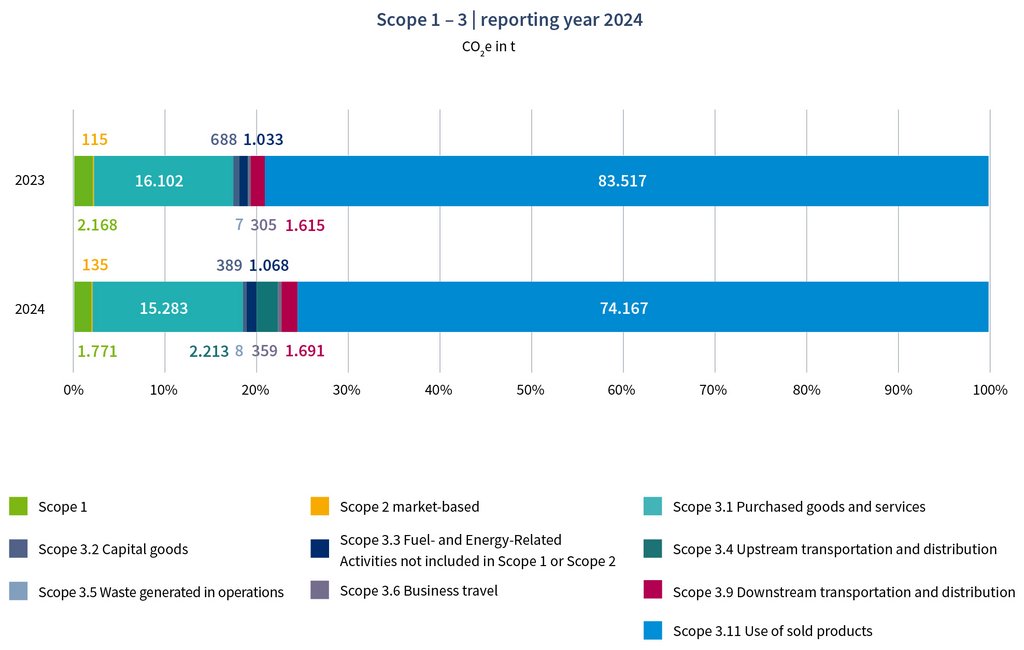
For our greenhouse gas reporting, we follow the Greenhouse Gas (GHG) Protocol and distinguish between Scope 1, 2, and 3:
•Scope 1: Direct emissions from our own activities, e.g., the use of natural gas in the combined heat and power plant and fossil fuels in parts of our car fleet.
•Scope 2: Indirect emissions from the electricity we purchase to operate our sites.
•Scope 3: Other indirect emissions from the upstream and downstream value chain, broken down into 15 categories (e.g., purchased goods, transportation, product use).
To establish an effective climate path, we have set two short-term targets for 2030 with the Science Based Targets initiative (SBTi) and had them validated. These targets are based on the 1.5°C path and cover Scope 1 and 2 as well as Scope 3, where relevant. They include the following targets „Brand Group SE & Co. KG commits to reduce absolute scope 1 and 2 GHG emissions 42.0% by 2030 from a 2023 base year. Brand Group SE & Co. KG also commits to reduce absolute scope 3 GHG emissions 25.0% within the same timeframe.“
Details on the validated targets are available on this page.
The majority of greenhouse gas emissions (Scope 1) generated by the company arise from the combustion of primary energy sources such as natural gas and fuel. Natural gas is used to generate electricity and heat for our office and production areas. Due to the nature of our business, no other gases or emissions are produced. Greenhouse gas equivalents from various databases are used as units of measurement, for example from the Emission Factor Database (EFDB) of the Intergovernmental Panel on Climate Change (IPCC) and Stadtwerke Wertheim GmbH.
We make the CO₂e footprint of our products transparent for our customers. We have introduced a systematic approach in accordance with DIN EN ISO 14067:2018 for all German locations of the Brand Group in order to determine the product carbon footprint (PCF) of our products. This approach has been validated by an independent testing agency.
Product Carbon FootprintSetting targets and reducing emissions
Greenhouse gas emissions have a significant impact on the development and consequences of climate change. Accordingly, we take responsibility for emissions generated during the manufacture and use of our products along the entire value chain. Greenhouse gas emissions have the greatest environmental impact.
Resource utilization and circular economy
In times of scarce natural resources, the efficient use of material and energy resources is becoming increasingly important. By resource use, we mean meeting demand with minimal use of raw materials. The circular economy also pursues the goal of keeping products and materials in the economic cycle for as long as possible through repair, reuse, recycling, and recovery. This allows us to reduce waste, lessen environmental impact, and tap into economic potential at the same time.
A key factor in reducing fuel consumption within the supplier network is the optimisation of shipments and routes – which is why we have set the following targets:
- BRAND GMBH + CO KG: The percentage of shipments meeting customer schedules is to be maintained at a constant 99%.
- VACUUBRAND GMBH + CO KG: The proportion of micro-shipments to trading partners is to be reduced from 25% to 10% by 2030, based on the baseline year of 2024.
- VITLAB GMBH: Each year, we contact the top three customers who receive small consignments to consolidate these into bulk shipments.
The most effective way to reduce resource wastage is to continue using a product. That is why we place great emphasis on quality and durability – supported by the fact that our products are easy to dismantle and repair.
Nevertheless, a product may reach the end of its life. In such cases, our aim is to make an active contribution to the circular economy. To this end, we design our products to be easily dismantled, thereby optimising the recovery of all possible resources.
In order to identify specific areas for improvement, we will conduct a comprehensive assessment of our product portfolio by 2027, based on defined criteria for the circular economy.
We are specifically reducing waste at source whilst improving waste management – with clear targets for our German production sites and a reduction in plastic packaging for our customers. Our aim is to reduce the Brand Group’s (DE) waste intensity from 3 tonnes of waste per million euros of turnover to 2 tonnes of waste per million euros of turnover. In addition, to reduce waste among our customers and clients, we aim to minimise the use of plastic packaging (virgin material). Where waste is nevertheless generated, sorting it by type improves waste management. The waste intensity target applies only to our production sites in Germany, as this is where the majority of the Group’s waste is generated.